Don't miss
Showing posts with label Thailand. Show all posts

Golden Temple - Thailand


The origins of this statue remain uncertain. It is made in the Sukhothai Dynasty style, and is thought to have been made during the Sukhothai period in the 13th-14th centuries, though it could have been made after that time.
The head of the statue is egg-shaped, which indicates its origin in the Sukothai period. Sukothai art had Indian influences. Metal figures of the Buddha made in India used to be taken to various countries for installation. So the Golden Buddha statue may have been cast in parts in India.

Later, the statue was probably moved from Sukhothai to Ayutthaya, after the latter kingdom came to predominate. This move may have happened in 1403.
(images)(source)

Buddha Park - Thailand


The park was started in 1958 by Luang Pu (Venerable Grandfather) Bunleua Sulilat. Luang Pu Bunleua Sulilat was a priest-shaman who integrated Hinduism and Buddhism. His unique perspective was influenced by a Hindu rishi under whom he studied in Vietnam. After the revolution in 1975, anxious about the repercussions of the rule of Pathet Lao, he fled from Laos to Thailand where he built another sculpture park, Sala Keoku in Nong Khai. Both parks are located right next to the Thai-Lao border (Mekong river), only a few kilometers apart from each other, and the tallest structures of the Buddha Park can actually be seen from the Thai side of Mekong.
(images)(source)

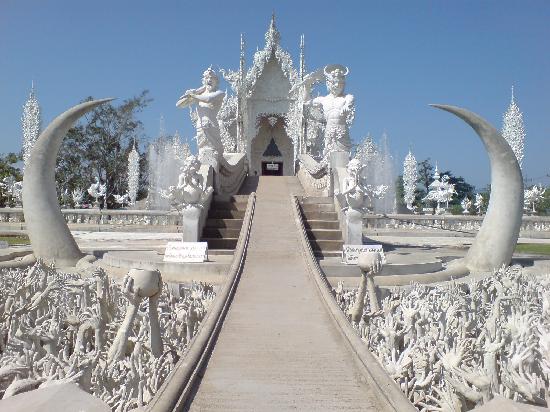
Wat Rong Khun - Thailand


Wat Rong Khun is a contemporary unconventional Buddhist temple in Chiang Rai, Thailand. It was designed by Chalermchai Kositpipat. Construction began in 1996 and is expected to be completed 60 - 90 years after the death of the artist and designer.
(images)(source)

Phi Phi Islands - Thailand


The Phi Phi Islands are located in Thailand, between the large island of Phuket and the western Andaman Sea coast of the mainland. The islands are administratively part of Krabi province. Ko Phi Phi Don is the largest island of the group, and is the most populated island of the group. although the beaches of the second largest island, Ko Phi Phi Lee (or "Ko Phi Phi Leh"), are visited by many people as well. The rest of the islands in the group, including Bida Nok, Bida Noi, and Bamboo Island (Ko Mai Phai), are not much more than large limestone rocks jutting out of the sea.

Phi Phi Don was initially populated by Muslim fishermen during the late 1940s, and later became a coconut plantation. The Thai population of Phi Phi Don remains more than 80% Muslim. The actual population however, if counting laborers, especially from the north-east, from the mainland is much more Buddhist these days. The population is between 2,000 to 3,000 people (2013).

The islands came to worldwide prominence when Ko Phi Phi Leh was used as a location for the 2000 British-American film The Beach. This attracted criticism, with claims that the film company had damaged the island's environment, since the producers bulldozed beach areas and planted palm trees to make it look like the book, an accusation the film's makers contest. The film's release was attributed to an increase in tourism to the islands. Phi Phi Leh also houses the 'Viking Cave', from which there is a thriving bird's nest soup industry.

Ko Phi Phi was devastated by the Indian Ocean Tsunami of December 2004, when nearly all of the island's infrastructure was destroyed. As of 2010 most, but not all, of this has been restored.
(source)

Grand Palace, Bangkok - Thailand


The Grand Palace is a complex of buildings at the heart of Bangkok, Thailand. The palace has been the official residence of the Kings of Siam (and later Thailand) since 1782. The king, his court and his royal government were based on the grounds of the palace until 1925. The present monarch, King Bhumibol Adulyadej (Rama IX), currently resides at Chitralada Palace, but the Grand Palace is still used for official events. Several royal ceremonies and state functions are held within the walls of the palace every year.

Construction of the palace began on 6 May 1782, at the order of King Buddha Yodfa Chulaloke (Rama I), the founder of the Chakri Dynasty, when he moved the capital city from Thonburi to Bangkok. Throughout successive reigns, many new buildings and structures were added, especially during the reign of King Chulalongkorn (Rama V). By 1925 the king, the Royal Family and the government were no longer permanently settled at the palace, and had moved to other residences. After the abolition of absolute monarchy in 1932 all government agencies completely moved out of the palace.
(source)

Rayavadee Krabi - Thailand


Situated at the heart of the stunning Phranang Peninsular on the edge of Krabi Marine National Park, Rayavadee nestles discreetly amidst tropical gardens and coconut groves against a backdrop of sheer cliffs, lush jungle foliage and the clear waters of the Andaman Sea. In addition to stylish, five-star accommodation, Rayavadee boasts fine cuisine, one of the most unique relaxation spas in Thailand and warm, attentive service.

Surrounded by breathtaking natural beauty, the resort is also the perfect Thailand honeymoon destination and setting for intimate, personalized wedding celebrations. Visit for the holiday of a lifetime and discover why Rayavadee truly is like nowhere else on earth…
(source)