Don't miss
Showing posts with label Italy. Show all posts

The Sistine Chapel in Rome - Italy


The Sistine Chapel in Rome - Italy

Arts of The Sistine Chapel in Rome - Italy

The Sistine Chapel in Rome - Italy

Arts of The Sistine Chapel in Rome - Italy

The Sistine Chapel in Rome - Italy


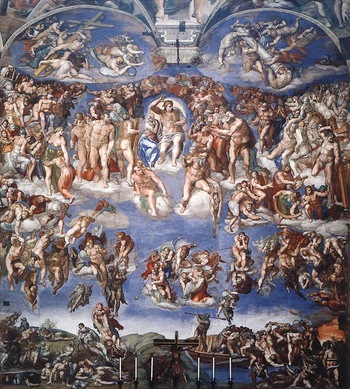
Sistine Chapel (Latin: Sacellum Sixtinum; Italian: Cappella Sistina) is the best-known chapel of the Apostolic Palace, the official residence of the Pope in the Vatican City. It is famous for its architecture and its decoration that was frescoed throughout by Renaissance artists including Michelangelo, Sandro Botticelli, Pietro Perugino, Pinturicchio and others. Under the patronage of Pope Julius II, Michelangelo painted 1,100 m2 (12,000 sq ft) of the chapel ceiling between 1508 and 1512. The ceiling, and especially The Last Judgment (1535–1541), is widely believed to be Michelangelo's crowning achievement in painting.

The chapel takes its name from Pope Sixtus IV, who restored the old Cappella Magna between 1477 and 1480. During this period a team of painters that included Pietro Perugino, Sandro Botticelli and Domenico Ghirlandaio created a series of frescoed panels depicting the life of Moses and the life of Christ, offset by papal portraits above and trompe l’oeil drapery below. These paintings were completed in 1482, and on 15 August 1483, Sixtus IV celebrated the first mass in the Sistine Chapel for the Feast of the Assumption, at which ceremony the chapel was consecrated and dedicated to the Virgin Mary.

Since the time of Sixtus IV, the chapel has served as a place of both religious and functionary papal activity. Today it is the site of the Papal conclave, the process by which a new Pope is selected.

(source)
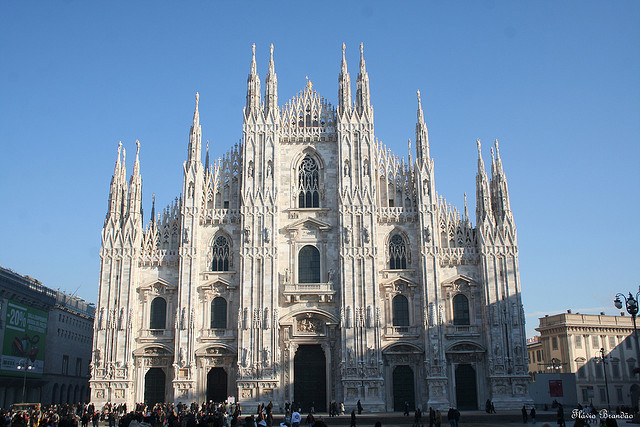
Milan Cathedral - Italy


Milan Cathedral - Italy Tour

Milan Cathedral - Italy Tour

Milan Cathedral - Italy Tour

Milan Cathedral - Italy


Milan Cathedral (Italian: Duomo di Milano; Lombard: Domm de Milan) is the cathedral church of Milan, Italy. Dedicated to Santa Maria Nascente (Saint Mary Nascent), it is the seat of the Archbishop of Milan, currently Cardinal Angelo Scola.

The Gothic cathedral took nearly six centuries to complete. It is the fifth largest cathedral in the world and the largest in the Italian state territory.
(source)

Colosseum, Rome - Italy


Colosseum, Rome - Italy Tour

Colosseum, Rome - Italy Tour

Colosseum, Rome - Italy Tour


The Colosseum or Coliseum, also known as the Flavian Amphitheatre (Latin: Amphitheatrum Flavium; Italian: Anfiteatro Flavio or Colosseo) is an elliptical amphitheatre in the centre of the city of Rome, Italy. Built of concrete and stone, it was largest amphitheatre of the Roman Empire, and is considered one of the greatest works of Roman architecture and engineering. It is the largest amphitheatre in the world.
The Colosseum is situated just east of the Roman Forum. Construction began under the emperor Vespasian in 70 AD,[ and was completed in 80 AD under his successor and heir Titus.Further modifications were made during the reign of Domitian (81–96).[ These three emperors are known as the Flavian dynasty, and the amphitheatre was named in Latin for its association with their family name (Flavius).


The Colosseum seated 50,000 spectators, and was used for gladiatorial contests and public spectacles such as mock sea battles, animal hunts, executions, re-enactments of famous battles, and dramas based on Classical mythology. The building ceased to be used for entertainment in the early medieval era. It was later reused for such purposes as housing, workshops, quarters for a religious order, a fortress, a quarry, and a Christian shrine.

Although in the 21st century it stays partially ruined because of damage caused by devastating earthquakes and stone-robbers, the Colosseum is an iconic symbol of Imperial Rome. It is one of Rome's most popular tourist attractions and still has close connections with the Roman Catholic Church, as each Good Friday the Pope leads a torchlit "Way of the Cross" procession that starts in the area around the Colosseum.
(source)

St. Peter's Basilica, Vatican City - Italy


St. Peter's Basilica, Vatican City - Italy

St. Peter's Basilica, Vatican City - Italy

St. Peter's Basilica, Vatican City - Italy

St. Peter's Basilica, Vatican City - Italy


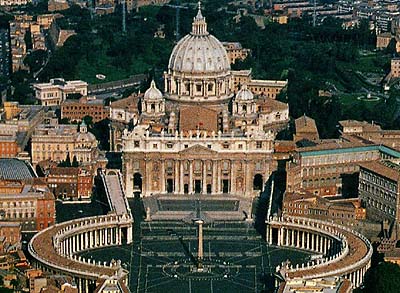
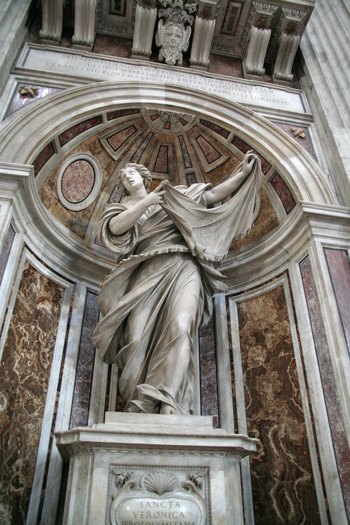
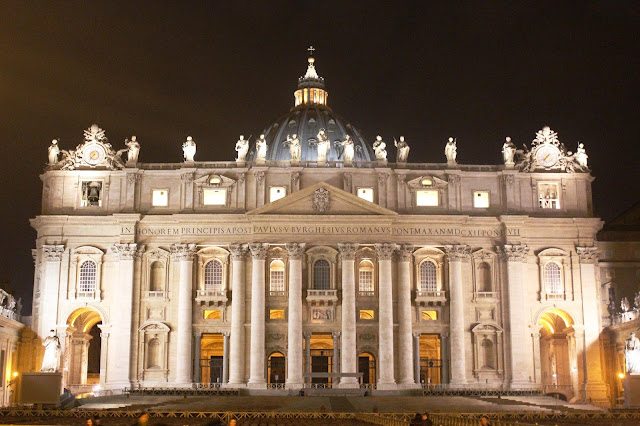
St. Peter's Basilica (Latin: Basilica Sancti Petri), officially known in Italian as Basilica di San Pietro in Vaticano or Basilica Papale di San Pietro is a Late Renaissance church located within Vatican City.

Designed principally by Donato Bramante, Michelangelo, Carlo Maderno and Gian Lorenzo Bernini, St. Peter's is the most renowned work of Renaissance architecture and remains one of the largest churches in the world. While it is neither the mother church of the Roman Catholic Church nor the cathedral of the Bishop of Rome, St. Peter's is regarded as one of the holiest Catholic sites. It has been described as "holding a unique position in the Christian world" and as "the greatest of all churches of Christendom".

In Roman Catholic tradition, the basilica is the burial site of its namesake Saint Peter, one of the twelve apostles of Jesus and, also according to tradition, the first Bishop of Rome and therefore first in the line of the papal succession. Tradition and some historical evidence hold that Saint Peter's tomb is directly below the altar of the basilica. For this reason, many Popes have been interred at St. Peter's since the Early Christian period. There has been a church on this site since the time of Constantine. Construction of the present basilica, replacing the Old St. Peter's Basilica of the 4th century, began on 18 April 1506 and was completed on 18 November 1626.
(source)

Leaning Tower of Pisa - Italy


Leaning Tower of Pisa - Italy

Leaning Tower of Pisa - Italy

Leaning Tower of Pisa - Italy

Leaning Tower of Pisa - Italy

Leaning Tower of Pisa - Italy


The Leaning Tower of Pisa (Italian: Torre pendente di Pisa) or simply the Tower of Pisa (Torre di Pisa) is the campanile, or freestanding bell tower, of the cathedral of the Italian city of Pisa, known worldwide for its unintended tilt to one side. It is situated behind the Cathedral and is the third oldest structure in Pisa's Cathedral Square (Piazza del Duomo) after the Cathedral and the Baptistry. The tower's tilt began during construction, caused by an inadequate foundation on ground too soft on one side to properly support the structure's weight. The tilt increased in the decades before the structure was completed, and gradually increased until the structure was stabilized (and the tilt partially corrected) by efforts in the late 20th and early 21st centuries.

The height of the tower is 55.86 m (183.27 ft) from the ground on the low side and 56.70 m (186.02 ft) on the high side. The width of the walls at the base is 4.09 m (13.42 ft) and at the top 2.48 m (8.14 ft). Its weight is estimated at 14,500 metric tons (16,000 short tons). The tower has 296 or 294 steps; the seventh floor has two fewer steps on the north-facing staircase. Prior to restoration work performed between 1990 and 2001, the tower leaned at an angle of 5.5 degrees, but the tower now leans at about 3.99 degrees. This means that the top of the tower is displaced horizontally 3.9 metres (12 ft 10 in) from where it would be if the structure were perfectly vertical.

The Spanish Steps, Rome - Italy


The Spanish Steps, Rome - Italy

The Spanish Steps, Rome - Italy

The Spanish Steps, Rome - Italy


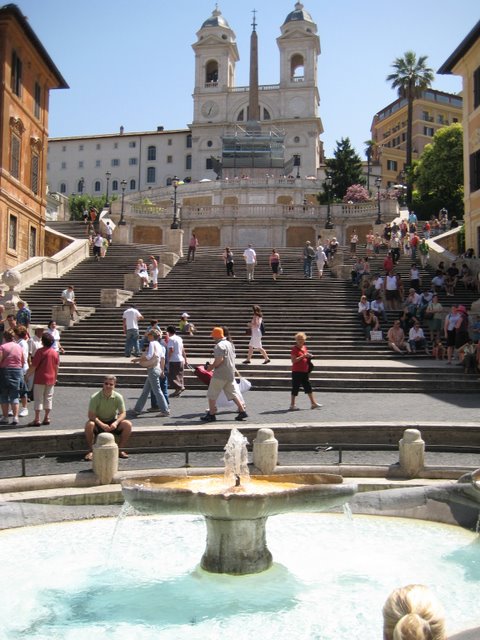
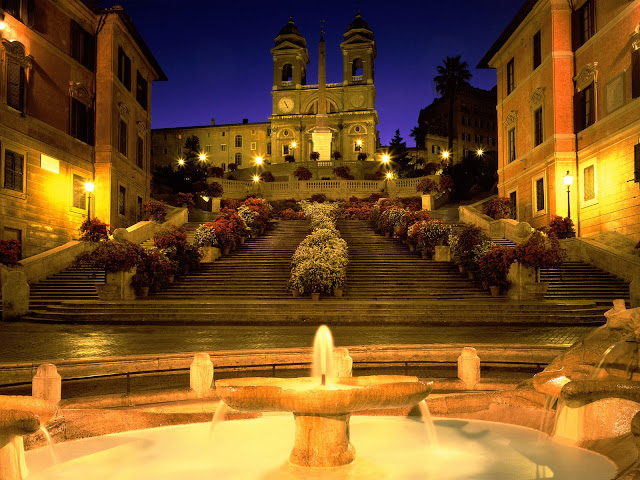
The Spanish Steps (Italian: Scalinata della Trinità dei Monti) are a set of steps in Rome, Italy, climbing a steep slope between the Piazza di Spagna at the base and Piazza Trinità dei Monti, dominated by the Trinità dei Monti church at the top. The Scalinata is the widest staircase in Europe.

The monumental stairway of 135 steps was built with French diplomat Étienne Gueffier’s bequeathed funds of 20,000 scudi, in 1723–1725, linking the Bourbon Spanish Embassy, and the Trinità dei Monti church that was under the patronage of the Bourbon kings of France, both located above - to the Holy See in Palazzo Monaldeschi located below. The stairway was designed by architects Francesco de Sanctis and Alessandro Specchi.
(source)

Trevi Fountain, Rome - Italy


Trevi Fountain, Rome - Italy

Trevi Fountain, Rome - Italy

Trevi Fountain, Rome - Italy

Trevi Fountain, Rome - Italy


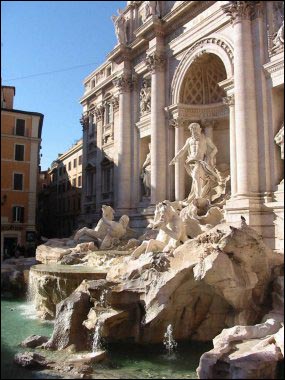
The Trevi Fountain is a fountain in the Trevi district in Rome, Italy. Standing 26.3 metres (86 ft) high and 49.15 metres (161.3 ft) wide,it is the largest Baroque fountain in the city and one of the most famous fountains in the world.

A traditional legend holds that if visitors throw a coin into the fountain, they are ensured a return to Rome.This was the theme of 1954's Three Coins in the Fountain and the Academy Award-winning song by that name which introduced the picture.
(source)

Bosco Verticale, Milan - Italy


Bosco Verticale (Vertical Forest) is a pair of residential towers in the Porta Nuova district of Milan, Italy, between Via Gaetano de Castillia and Via Federico Confalonieri near Milano Porta Garibaldi railway station. They have a height of 119 meters and 87 meters and will host more than 900 trees (approximately 550 and 350 trees in the first and second towers) on 8,900 square metres (96,000 sq ft) of terraces. The structure was completed in the first quarter 2012 and the project is currently proceeding with the construction of facades and facilities.

The towers were designed by Stefano Boeri, Gianandrea Barreca and Giovanni La Varra. It also involved input from horticulturalists and botanists.

Completion is expected by mid-2013. Within the complex is also an 11-story office building; its facade will not host plants.
(images)(source)

Blue Grotto, Capri - Italy


The Blue Grotto is a noted sea cave on the coast of the island of Capri, Italy. Sunlight, passing through an underwater cavity and shining through the seawater, creates a blue reflection that illuminates the cavern.

The grotto was known by the Romans, as proved by the antique statues which were found in the Grotto.This discovery, the remains of an ancient landing place and the work on an underground tunnel, create an image of a natural cavern adorned by statues. The grotto was known to the locals under the name of Gradola, after the nearby landing place of Gradola, but it was avoided because it was said to be inhabited by witches and monsters.
(images)(source)

The Appennine Colossus - Italy


Measuring about 35 feet tall, it’s arguably the most spectacular feature of the gardens of Villa Medici at Pratolino, now part of Villa Demidoff, located about 7 miles north of Florence, Italy. A personification of the Apennine mountain ranges, it’s sculpted as though on that minimal margin between landscape and man, its smooth skin emerging out of the rough terrain or metamorphosing back into a mountain. He even has stalactites for a shaggy beard.

This colossal sculpture recalls the figure of Atlas in Virgil’s Aeneid, and also the architect Dinocrates’ proposal to shape Mount Athos into a man in honor of Alexander the Great.
(images)(source)

Sardinia - Italy


Sardinia  is the second largest island in the Mediterranean Sea(after Sicily and before Cyprus) and an autonomous region of Italy. The nearest land masses are (clockwise from north) the island of Corsica, theItalian Peninsula, Sicily, Tunisia and the Balearic Islands.
(source)

Capri Beach - Italy


Capri is an island in the Tyrrhenian Sea off the Sorrentine Peninsula, on the south side of the Gulf of Naples in the Campania region of Italy. The main town Capri on the island shares the name. It has been a resort since the time of the Roman Republic.

Features of the island are the Marina Piccola (the little harbour), the Belvedere of Tragara (a high panoramic promenade lined with villas), the limestone crags called sea stacks that project above the sea (the Faraglioni), the town of Anacapri, the Blue Grotto (Grotta Azzurra), and the ruins of the Imperial Roman villas.
Capri is part of the region of Campania, Province of Naples. The town of Capri is the island's main population centre. The island has two harbours, Marina Piccola and Marina Grande (the main port of the island). The separate comune of Anacapri is located high on the hills to the west.
(source)